Manager of Managers: How Your Role Changes at Each Career Level
I became a manager of managers for the first time in a multinational company, and I did not do it well. Until then I managed a team of 10 individual contributors. Then the org structure changed, and I was managing three line managers.
The promotion came from the org structure, hiring needs and team requirements. Nobody trained me on how to manage line managers.
So I did one of two things. Either I behaved like a line manager myself, or I stepped back completely and assumed the line managers would handle it. Too close or too far, and I kept missing the middle.
Some time later the structure changed again, I lost that team, and I went back to working as a line manager. That stretch taught me what goes wrong and what it costs. When the next chance came a couple of years later, I knew how the job works.
This post is the framework I built from it.
The 30 second version
- Individual contributor: you deliver the work assigned to you, yourself.
- Line manager: you do the same kind of work as your team, and you help them deliver theirs.
- Manager of managers: most of your team are managers, so your main job is setting the rules for how you work together.
- Individual contribution never fully stops, at any level.
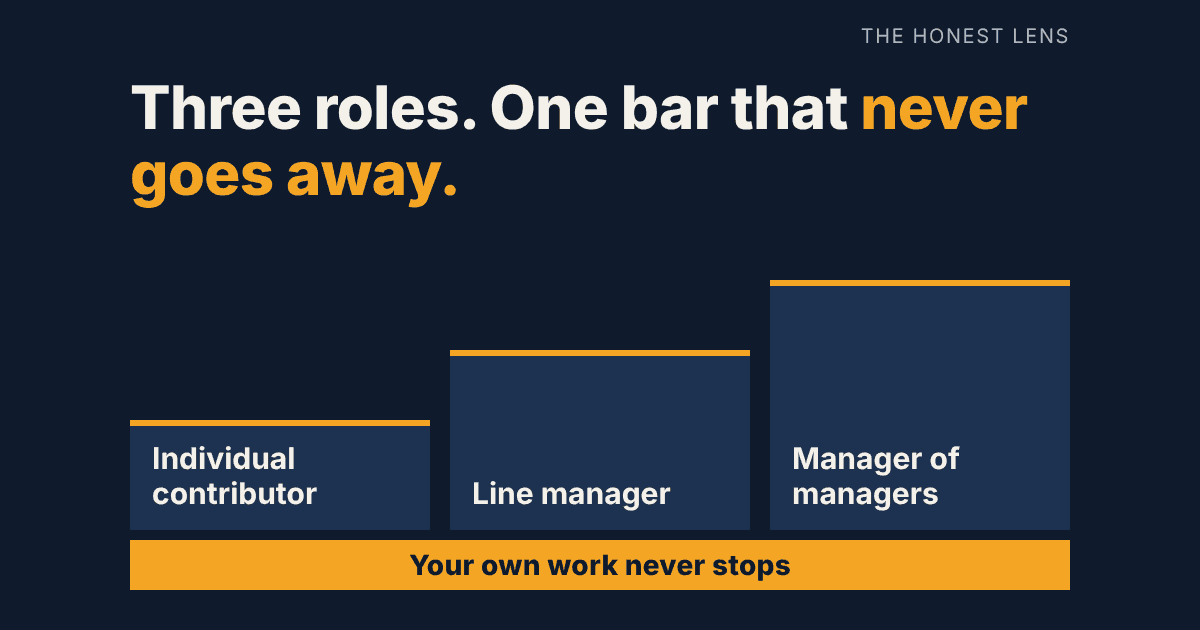
Table of Contents
Individual contributor: you deliver your own work
Almost everyone starts here. You deliver what is assigned to you, and you do it yourself.
Nobody reports to you. You have peers and seniors, and you may give a peer some work, but as a request or a favour. It is not an official assignment, unless your manager reassigns it.
Your focus is finishing your own work.
Line manager: your own work plus your team’s
At the second level you manage individual contributors. The title can be lead, manager or anything else. What matters is that a few people work on assignments you give them, and you are the key person in their job.
You assist them, train them, monitor them and mentor them. Others in the ecosystem may help too, but these people are primarily responsible to you.
You also have significant work of your own. If I am a lead, I may be programming one component while my team members program other components of the same module. I help them code better, and I code mine.
The work is the same type as theirs. Only the quantity differs, because part of my time now goes into their output.
Here the first skill change shows up. You have to know when to micromanage and when to manage at a macro level. Overstep, and you will not get good value from the team’s output.
Manager of managers: the job I got wrong
The third level is where your team is mostly line managers. You may still have a few individual contributors, but the managers are your significant team.
The skill set changes again, and this time nobody hands you a manual. Line managers are doing significant work with their own teams. They need autonomy, and some decisions still have to be aligned with yours.
That is where I failed. Too close, and I was a second line manager sitting above the first one. Too far, and I was assuming things were happening.
Draw the lines between your decisions and theirs, and write them down. Writing it down gives both sides clarity on when you will step in, and when you will talk to the individual contributor reporting into them.
What to settle with each line manager
Nobody gave me this list the first time. Copy it and settle it with each of your line managers.
Skip-level meetings
- When they happen
- How they run
- What assignments, if any, you give directly
- How the arrangement works day to day
Decision rights
- Areas they can decide and act on themselves
- Areas where they should involve you
- Areas where you decide, and areas where you only need to be aware
- How they work with peers in the wider ecosystem
Individual contribution never stops
Every person has work that maps to their own responsibility and cannot be delegated. That is true for a team lead, and it is true for a chairman, CEO, MD, CTO or chief strategy officer.
Team members may do preparation work or the work in their own areas. Your part is still yours.
What changes is how much of your own work looks like your team’s work. As a line manager, a lot of it does. As a manager of managers, much less.
At CEO or MD level, the board is your boss
As a CXO, I have seen that the structure at the top is different. A CEO or MD does not have one boss. The board works as a group, so the whole board is your boss.
Most of your reportees are chief officers of some function: sales, strategy, human resources, technology, legal. You may have a few individual contributors, such as an executive assistant, but most of your team are managers of some level.
Below this level there is a lot of flexibility, and much depends on the individual. At CEO or MD level, governance and compliance take over. A defined process, regulators and industry best practice decide who is responsible for what. The responsibilities of a CHRO, for example, are largely defined by regulation, compliance requirements and best practice.
I have not listed which rule applies to which role. For your own company, check its governance documents and the applicable law.
This is not a new type of role. After manager of managers, you keep managing managers, one layer higher each time.
What keeps changing as you move up
These shift at every level:
- The skill set you need
- The type of managers you manage
- Your responsibility
- Your accountability metrics
- The review process
- The ownership process
Once you understand the pattern, you start practising it. Then you keep tweaking until you work out how to run your team well.
My takeaway
Know which of the three roles you are in this year, and ask what has to change in how you work. If you are about to manage managers, write the decision rights down before you need them.
FAQ
What is a manager of managers?
Someone whose direct reports are mostly managers, each leading their own team of individual contributors. They may have a few individual contributors too, such as an assistant.
Is managing managers harder than managing individual contributors?
It was for me. The skill set changes, and I had no training for it. I either hovered over the line managers or left them alone.
Does a manager of managers still do individual work?
Yes. Every role has some work that cannot be delegated. The share goes down as you move up, but it does not reach zero.
How often should skip-level meetings happen?
I do not have a fixed number to give. Decide when and how they happen, and put it in writing. The protocol matters more than the number.