Job Security vs Career Security: The Three Risks Nobody Reminds You About
The 30 second version
- The work we do falls into three kinds: protecting your career, protecting your job, and earning a promotion.
- Promotion work is the most visible and takes most of our time. It is also the least valuable.
- Career and job protection is invisible. Nobody asks for an update, and it decides whether you stay employable.
- Nobody funds a key risk until it is a risk to them. If it goes wrong, you carry it.
- Put that hidden work in your own diary. Nobody else will.
Job security vs career security became a real question for me after a conversation with one of my bosses, some years back. Cybersecurity was not a priority for most senior management or boards then. The situation, as I remember it: if an attack on the company’s website became public, the CTO’s job and career were over.
My boss told me about a CTO whose company had been hacked, and who was now looking for a job. He said he would hesitate to hire that person, because the CTO had not been able to protect his company’s website from the hackers.
That conversation opened my eyes. Nobody gives you enough resources and time to work on a key risk unless it is a risk to them. If something goes wrong, they will hold you responsible, and if it becomes public, your career is at risk.
Since then I have believed the work we do falls into three kinds. One kind protects your career. One protects your job. One earns you a promotion or a good appraisal. Most professionals spend nearly all their time on the third kind, and I think it is the least valuable of the three.
Table of Contents
The three risks at a glance
| What goes wrong | Who sees it | What it costs | |
|---|---|---|---|
| Type 1: Career risk | Your area is linked to a fraud, a breach or a public failure | The public, regulators, future employers | Possible litigation, and a mark that follows you |
| Type 2: Job risk | The company decides you could have prevented a problem and did not | Only the company | This job |
| Type 3: Promotion risk | A project or initiative misses its target | Your manager, senior management | A smaller raise, a later promotion |
Job security vs career security: where the line sits
Job security is whether this employer keeps you. Career security is whether your name stays clean wherever you go next. Type 2 threatens the first. Type 1 threatens the second, and it travels with you.
Career security is often described as skills and employability. Those matter. I mean something narrower: whether your professional record carries a failure you were responsible for.
Both risks come from the same two causes:
- Omission: something you were supposed to do and did not.
- Commission: something you did that you were not supposed to do.
The trigger is the same. The damage depends on how public the outcome becomes.
Type 1: the risk that follows you
Take a cyber attack at your company. An investigation follows. If it finds a control you were meant to run and did not, or a shortcut you took and should not have, you are no longer a bystander. Your name is in that story. A new employer reads your profile, sees the company and the period, and starts doubting your skills and your sense of responsibility.
It is not only technology. In banking, if a fraud happens and you are somehow associated with it, you can end up in litigation. The test is the same in any profession: could this link your name to a lawsuit or a public failure in your area? If yes, it belongs here.
Uber’s former security chief was convicted in 2022. The conviction was not for the breach itself but for how it was handled, including keeping it from the US regulator. That is commission at the extreme end. Most Type 1 cases are quieter.
I am not a lawyer. What happens to you depends on where you work and what you signed, so ask your own legal adviser what personal cover you have.
Type 2: the risk only your company sees
Type 2 never reaches the public. No litigation links to you, and the brand is not in trouble because of you. But something went wrong that hurt the business, and internally the company concludes you could have avoided it, or helped it do better, and did not. Again it is either something you skipped or something you did that you should not have.
You may not be the primary owner. You may only be party to the issue. The company can still act against you.
The same incident can be Type 2 for you and Type 1 for the person who owned it.
Type 3: the risk everyone asks about
Type 3 is the project that misses its target, the initiative that stalls, the revenue or cost goal you did not hit. The result is a smaller raise or a promotion that waits.
This is the work with an audience. Your manager wants an update. Senior management wants an update. Revenue should rise, cost should fall, hiring should move, and everyone is watching for progress. It also gives you visibility, so you do need to do it well.
I still rate it the least critical of the three, and I will defend that. It eats the most time and energy of anything you do, and the worst outcome is a slower climb.
The reverse pyramid
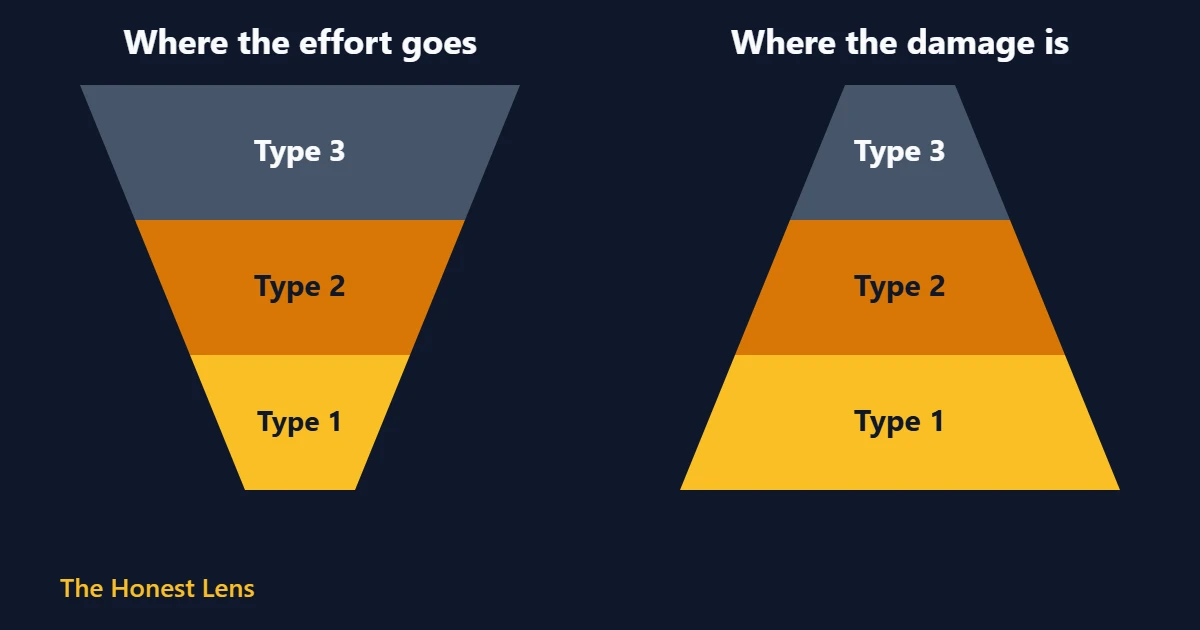
Think about where your last month went. My estimate, not a measured number, is that most people put 80 to 90 per cent of their effort into Type 3. Types 2 and 1 share what is left.
The impact runs the other way. It looks like Maslow’s hierarchy of needs: the base carries everything, and promotion sits at the top.
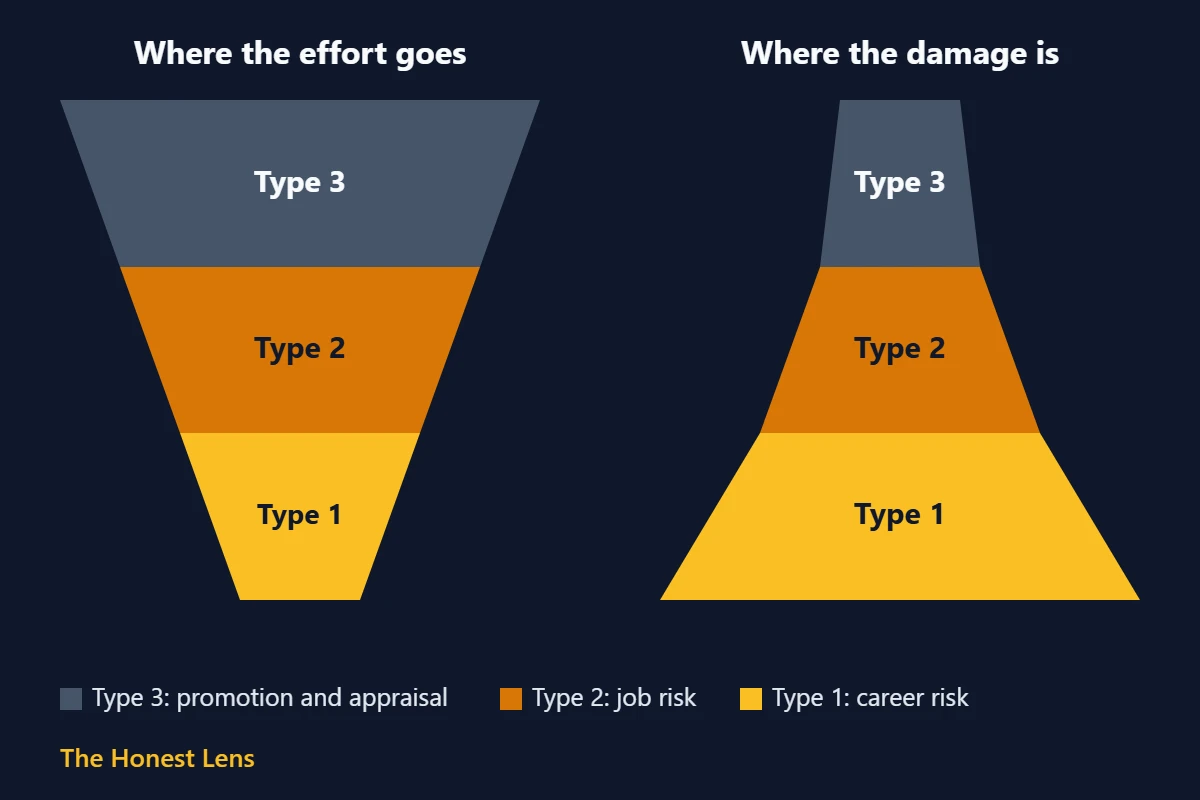
Types 1 and 2 only come up when something forces them: a compliance review, an audit checklist, an incident. That may be once a quarter or once a year, in some forum. By then it needs real movement, and it is late.
Nobody chases you for the work that protects you.
What I would put in the diary
Keep doing Type 3. Just stop letting it take the whole week. These are the hidden tasks I would schedule for a technology leader. If you work in another field, swap in the equivalent controls from yours.
Every week
- Read the open audit and security findings in your area, and check the oldest one has an owner and a date.
- Look at who holds privileged access, and whether anyone has left or moved.
- Write down any exception or shortcut you approved, and why.
Every month
- Test one thing you are told works: restore a backup, run a failover, check that an alert reaches a person.
- Confirm your responsibilities are written down in your role description or a signed document, so nobody argues later about what was yours.
Every quarter
- When someone declines a recommendation of yours, get that decision in writing from them.
- Walk through the incident plan with the people who would run it.
Frequently asked questions
What is the difference between job security and career security?
Job security is whether your current employer keeps you. Career security is whether your professional record stays clean and employable wherever you go next.
What is a career risk?
It is anything that can link your name to litigation, public blame or a damaged brand because of work you were responsible for. Fraud and cyber incidents are the obvious examples.
Can I be blamed for something I was only partly responsible for?
Inside the company, yes. That is a Type 2 risk. Whether it goes further depends on the facts and the law where you work, so ask your own adviser.
How much time should protection work get?
I do not have a number. Start by giving it a fixed slot in your week, then raise it if your role carries more exposure.
My takeaway
Keep delivering the visible work, and give the hidden work a fixed place in your week. It is the only part of your job that nobody will chase you for.