
FIRE Number India: A Worked Example for a Couple Spending ₹1 Lakh a Month
I work out my FIRE number India style: in Excel, in rupees, against Indian inflation, and until the money runs to zero at age 100. My own numbers stay private, so this post runs the same method on a made-up couple who spend ₹1 lakh a month.
The 30 second version
- A multiple like 25x or 33x is a shortcut. It hides what decides your number: how long you live, the gap between portfolio growth and inflation, and the large one-off costs.
- For a couple spending ₹12 lakh a year, my model gives ₹4.37 crore at 40 and ₹3.94 crore at 50, with a 2% gap and money lasting to 100.
- Add a car every ten years, special trips and a medical buffer, and the same couple needs about ₹5.67 crore at 40.
- The gap moves the number more than age does. At 40, a 1% gap instead of 2% adds ₹1.16 crore.
Table of Contents
Why one multiple is not enough
Most FIRE advice in India hands you a multiple of yearly spending. Divide by 4% and you get 25x. Divide by 3.3% and you get about 30x. Divide by 3% and you get about 33x. Each is the result of someone else’s assumptions about how long you live and how fast prices rise.
For ₹12 lakh a year, those three multiples give ₹3 crore, ₹3.6 crore and ₹4 crore. A ₹1 crore spread is too wide to settle with a rule of thumb, so I stopped using one and built the calculation myself.
The couple and the ₹12 lakh
Both are 40, no children. After they stop working they spend ₹1 lakh a month, so ₹12 lakh a year. That is the whole year, not only the monthly bills: regular spending, insurance premiums, the travel they would do anyway, and the costs that arrive once a year. Costs tied to a job, like commuting and work clothes, drop away.
I treat ₹12 lakh as what they spend in the first year after retiring, whenever that is. That matters when I compare retiring at 40, 45 and 50.
Three assumptions that decide the number
How long the money must last
I made the corpus reach zero at age 100. That is aggressive, and 100 is a very hard age to reach. I chose it on purpose, because when you plan for risk the worst case is the number to plan for. My wife and I are the same age, so one date covered both of us. If your partner is younger, plan to their date.
Stopping at 90 instead of 100 brings the couple’s number at 40 down from ₹4.37 crore to ₹3.94 crore. Those ten extra years cost about ₹43 lakh.
Inflation and the growth gap
Spending rises every year. I use 6% inflation on the whole ₹12 lakh, which turns it into about ₹21.5 lakh in ten years. Medical and insurance costs usually rise faster, and I test that below.
The portfolio earns a return after tax, and what matters is the gap between that return and inflation. A 2% gap means 8% growth against 6% inflation. I look at the gap rather than the return alone because many investments move with inflation: when inflation rises, interest rates tend to rise too.
The gap is the risk you choose to take. A small gap is safe and needs a big corpus. A large gap needs less money and breaks more easily. I used 1% and 2%, and show 3% for comparison.
One-off costs and a buffer
The ₹12 lakh covers life as it normally runs. A car, a special international trip or a house repair sits outside it, and you need corpus for those too. On top of that sits a medical and emergency buffer that you leave alone.
I enter every one-off in today’s rupees. A ₹20 lakh car today is about ₹27 lakh in five years at 6% inflation, but the corpus that pays for it has grown over those five years as well. So I put in ₹20 lakh, and the model does the inflating and the growing.
How I built it in Excel
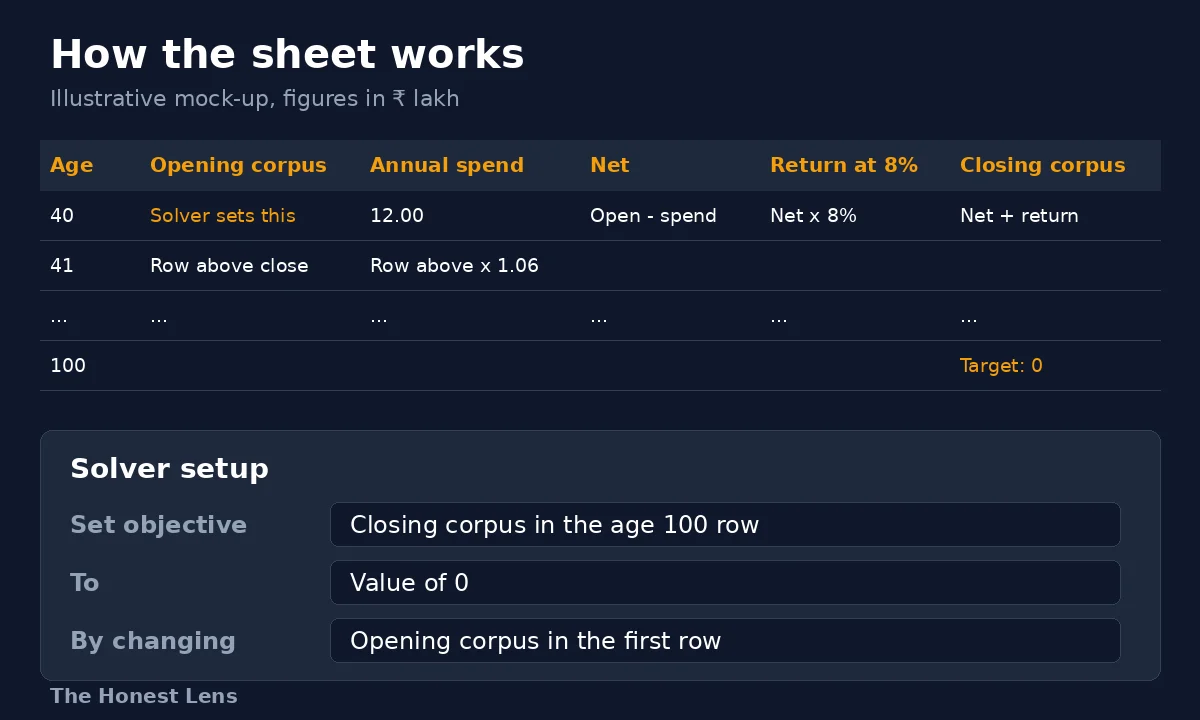
I do this with Excel’s Solver. The sheet has one row per year and six columns:
- Age: your retirement age in the first row, then one more in each row down to 100.
- Opening corpus: a guess in the first row. Every later row takes the closing corpus of the row above.
- Annual spend: ₹12 lakh in the first row. Each later row is the previous year’s spend times 1.06.
- Net: opening corpus minus annual spend.
- Return: net times the growth rate. Mine is 8%, which is 6% inflation plus a 2% gap, from a hybrid portfolio with part in equity and part in debt.
- Closing corpus: net plus return.
Here are the first two rows with a guess of ₹1 crore, in ₹ lakh:
| Age | Opening corpus | Annual spend | Net | Return at 8% | Closing corpus |
|---|---|---|---|---|---|
| 40 | 100.00 | 12.00 | 88.00 | 7.04 | 95.04 |
| 41 | 95.04 | 12.72 | 82.32 | 6.59 | 88.91 |
Copy the row down to age 100. A ₹1 crore guess runs out long before that, and Solver fixes it. Set the closing corpus in the age 100 row as the target cell, set its value to 0, and let Solver change the opening corpus in the first row. It iterates until the last row ends at zero. The opening corpus it lands on is your FIRE number.
For a car or a trip, I add the amount to that year’s spend, entered in today’s money. The same 6% inflation grows it. The buffer goes on top of the opening corpus.
Run it again at a 1% gap and with your own medical inflation.
The numbers: the same couple at 40, 45 and 50
This table covers regular spending only, funded to age 100. All figures are in ₹ crore.
| Retire at | Years to fund | 1% gap | 2% gap | 3% gap |
|---|---|---|---|---|
| 40 | 60 | 5.53 | 4.37 | 3.54 |
| 45 | 55 | 5.18 | 4.16 | 3.42 |
| 50 | 50 | 4.81 | 3.94 | 3.28 |
| 55 | 45 | 4.42 | 3.69 | 3.12 |
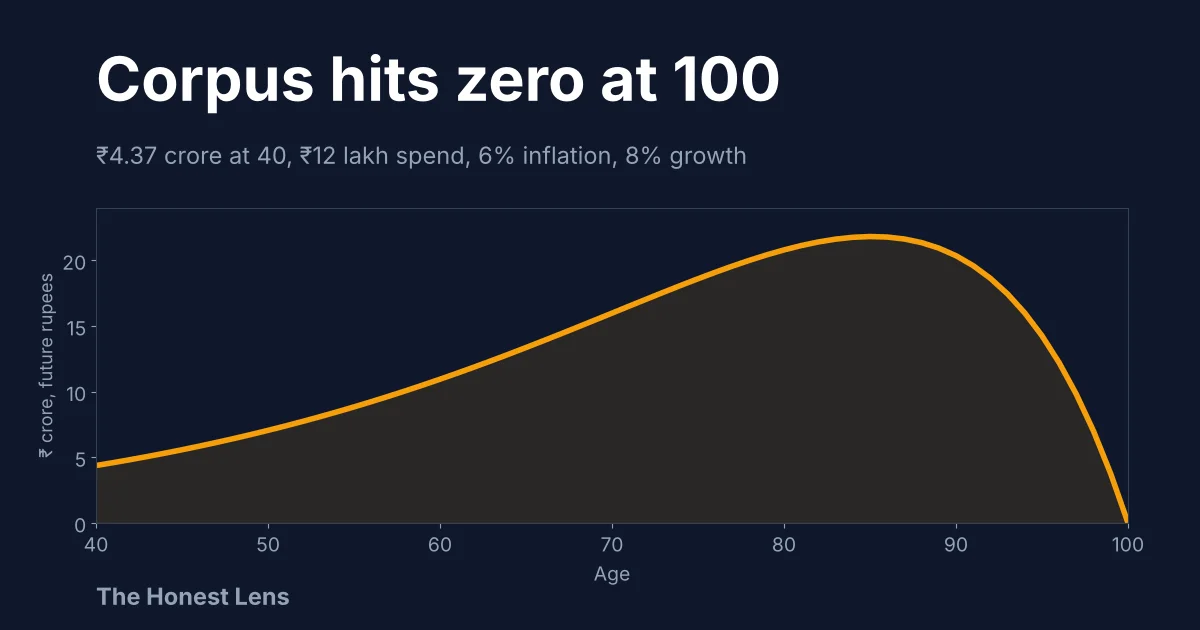
At a 2% gap, the multiples come out near 36x at 40, 35x at 45, 33x at 50 and 31x at 55. The 33x that people quote is about right for a 50-year-old and light for a 40-year-old.
Waiting from 40 to 45 cuts the need by only about ₹21 lakh. In my view the real gain from waiting is five more years of saving, not a smaller target.
The gap matters more than age. At 40, moving from a 2% gap to 1% adds ₹1.16 crore. Moving from retiring at 40 to retiring at 50 saves ₹43 lakh.
One trap: if you are 40 today and plan to stop at 45, today’s ₹12 lakh becomes about ₹16 lakh by then at 6% inflation. Use ₹16 lakh as the first-year spend.
Adding the car, the trips and the buffer
I added three things to the same couple, all in today’s rupees: a ₹20 lakh car every ten years starting in year 5, a ₹5 lakh special trip every five years, and a ₹25 lakh medical and emergency buffer. These are my illustrative choices. Swap in yours.
All figures are in ₹ crore, at a 2% gap, funded to 100.
| Retire at | Regular spend only | Plus car and trips | Plus buffer | Multiple of ₹12 lakh |
|---|---|---|---|---|
| 40 | 4.37 | 5.42 | 5.67 | 47x |
| 45 | 4.16 | 5.12 | 5.37 | 45x |
| 50 | 3.94 | 4.87 | 5.12 | 43x |
The one-offs add close to ₹1 crore. The ₹12 lakh of regular spending is only about 2.1% of the ₹5.67 crore at 40. The 3% to 4% rules do not account for cars and trips, and that is why they leave a couple like this short.
I also tested medical inflation. Suppose ₹2 lakh of the ₹12 lakh is insurance and medical, and that part rises 9% a year while the rest rises 6%. The base number at 40 goes from ₹4.37 crore to ₹5.24 crore, which is ₹87 lakh more. The ₹2 lakh and the 9% are my assumptions, not data.
Equity and debt: how the corpus pays you
The corpus is not one pot. Part sits in equity and part in debt. Expenses do not stop when markets fall, so in a bad year the debt part pays the bills and you do not sell equity at a low. In a good year, refill the debt part first, so it is full before the next bad stretch. Equity gets topped up after that.
How large the debt part should be depends on your own risk appetite, and I will not hand out a number here. The sheet assumes the same return every year. Markets do not behave like that, and the debt part is what protects the plan from it.
What I am not sure about
- Returns are not guaranteed. A 2% gap is a planning assumption, and a bad decade can break it.
- I treat returns as after tax and have not modelled tax rules here. Check yours.
- 6% inflation is an assumption, not a forecast. Stress it at a higher number.
FAQ
What is a FIRE number in India?
It is the corpus that lets you stop working and still pay for your spending, with inflation, until the end of your life.
Is the 4% rule safe in India?
I would not rely on it alone. It came from US data, where inflation runs lower than ours. A rule gives you one number, and the sheet shows you what moves it.
How much do I need if I spend ₹1 lakh a month?
For the couple here, ₹3.94 crore to ₹4.37 crore for regular spending between ages 50 and 40 at a 2% gap. With a car, trips and a buffer, ₹5.12 crore to ₹5.67 crore.
Does retiring at 45 instead of 40 change the number much?
Not much: about ₹21 lakh at a 2% gap. It changes how long you get to save. Inflate your spending to the year you stop.
Related reading
- FIRE for Indians: Reality or Myth?
- Geo-Arbitrage: Turbocharge your FIRE in India
- Early Retirement Planning in India: 6 Steps After 40
Last reviewed: November 2026. I am not a licensed financial adviser. This is a worked example, not a recommendation. Run your own numbers.