CTO Salary in India: What the Pay Is Actually Made Of
CTO salary in India is a search where every page gives a different answer. I have worked in a listed company and in startups at different funding stages, and the same title meant a different pay structure each time. This post explains how that pay is built, so you can judge an offer and aim at the right kind of company. I am leaving my own figures out. The structure is more useful to you than my numbers.
The 30 second version
- The CTO title does not set the pay. Company size, the peers next to you and the risk the company carries do.
- Published salary figures disagree because they average very different companies.
- A CTO package has more parts than a salary: variable pay, equity, bonuses and deferred pay.
- Equity is taxed twice, and the first tax arrives before you have sold anything.
- Read the leaver clause in the equity policy before you look at the size of the grant.
Table of Contents
Why every CTO salary page gives a different number
The pages that rank for this search are mostly salary aggregators, education sellers and HR sites. Their numbers do not agree.
| Source | What it says | Worth knowing |
|---|---|---|
| EICTA (IIT Kanpur) | ₹4 lakh to ₹12.5 lakh a month, which is ₹48 lakh to ₹1.5 crore a year | Base salary only. Bonus, stock and long-term incentives are excluded |
| Jaro Education | ₹45 lakh to ₹1.2 crore a year | An average range for 2026 |
| Payscale | About ₹41.6 lakh average base | Bonus is listed separately |
| AmbitionBox | ₹12 lakh to ₹1 crore a year | Built from salaries reported by users |
I have not checked how any of these samples were collected. My read is simpler. None of them is wrong. Each averages a five-person startup together with a company that turns over thousands of crores, and calls both “CTO”.
A base-only figure and a total-pay figure are also different numbers. Many pages do not say which one they show.
The title is a responsibility, not a pay grade
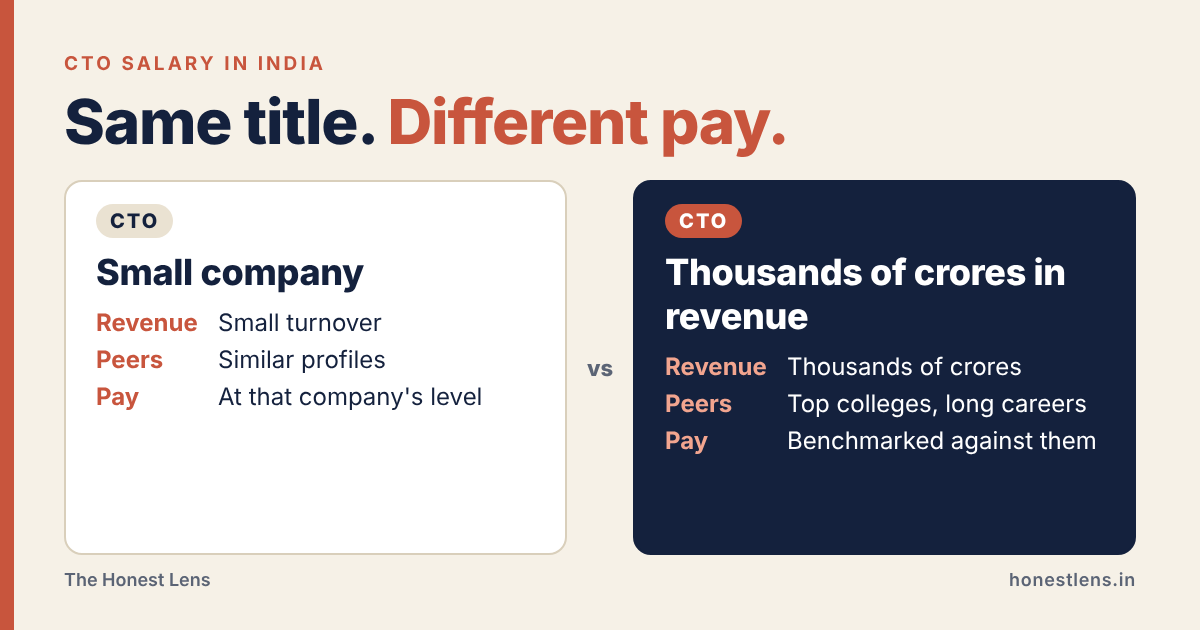
A CTO can have 5 years of experience or 25. The title tells you who is accountable for technology. It does not tell you what the company pays for that.
What sets the pay:
- Company size and revenue. The same title pays differently in a company with a small turnover and in one with thousands of crores in revenue.
- Your peer set. If the people around you come from strong colleges and long careers, your pay is benchmarked against them.
- Your own profile. Years of experience count, but so does the kind of profile you bring.
- The company’s risk and the moment you negotiate. A company in a hurry or in trouble offers a different mix from a stable one.
Take a person with 25 years of experience in a small company, among peers with similar profiles. That person will be paid at that company’s level, whatever the title says.
The title is a responsibility. The pay is a market price set by the environment you sit in.
What is inside a CTO offer
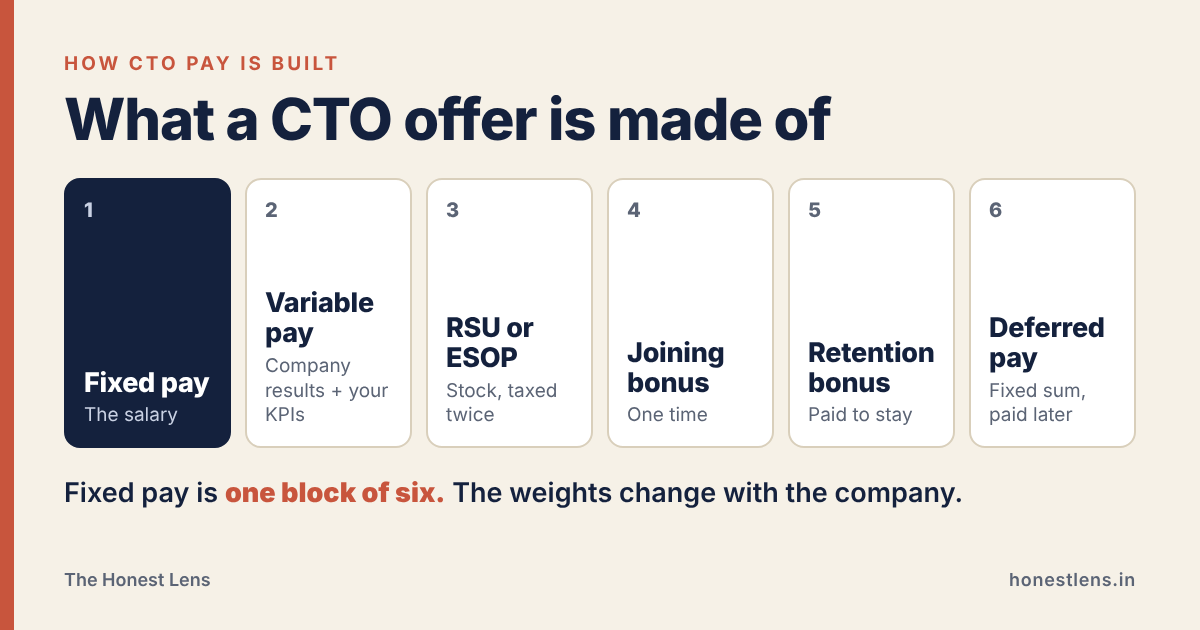
A CTO offer is rarely only a salary. These are the parts I saw. Their weight changes with the company.
- Fixed pay
- Variable pay and performance incentives
- RSUs or ESOPs
- Joining bonus
- Retention bonus
- Notice-period terms
- Deferred pay
How heavy each part is depends on the environment, the risk the company carries and what you negotiate.
Variable pay
At the peak of my CTO career, about 20% of total pay was variable. It depended on two things: how the company did, and how I did against my own KPIs. At CXO level both count. The payout was different when only one of the two had delivered.
Stock and deferred pay
Stock and deferred pay both exist to keep you in the company. They work differently.
Deferred pay is a fixed sum that arrives with time. It cannot make you wealthy. It can only keep you.
Stock can build wealth, and it can also disappoint.
ESOP and RSU
An earlier employer of mine used ESOPs. A later one used RSUs, and the RSUs were a significant part of my package.
With an ESOP you buy the shares at a price set when the option was granted, usually at a discount to the market. With an RSU the shares come at a nominal price or free.
The equity tax most people do not see coming
Equity is taxed twice.
- When the shares reach your demat account. You become the owner. The difference between the market value that day and what you paid is taxed as salary, at your normal income-tax rate. This holds for listed and unlisted shares.
- When you sell. Capital gains tax applies. Your cost is the market value on which you already paid salary tax, not what you originally paid.
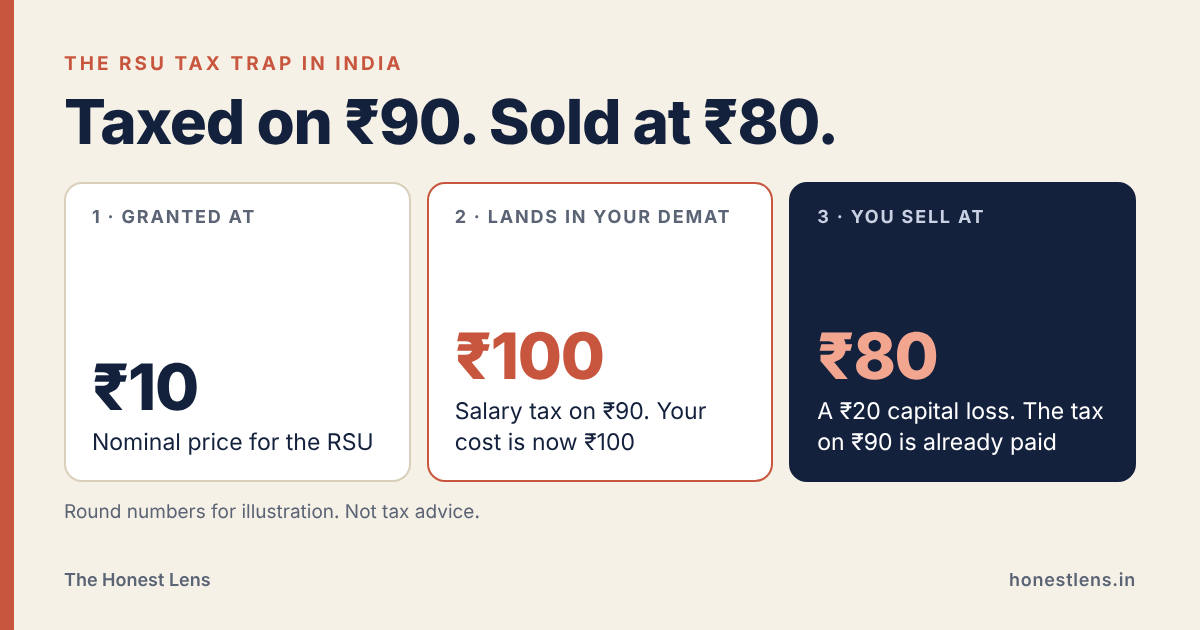
Here is an example in round numbers. An RSU is granted at ₹10. On the day it lands in your demat account, the market value is ₹100. You pay salary tax on ₹90. Your cost for capital gains is now ₹100.
- If you sell at ₹150, the gain is ₹50. It is short-term or long-term depending on how long you held the shares.
- If you sell at ₹80, you have a ₹20 capital loss. You already paid tax on a ₹90 gain you never kept.
You can set a capital loss against other capital gains. You cannot set it against your salary. A short-term loss can be set against short-term and long-term gains. A long-term loss can be set only against long-term gains. Unused losses carry forward for up to 8 assessment years.
The rules that matter after 23 July 2024:
| Listed shares | Unlisted shares | |
|---|---|---|
| Long-term after | More than 12 months | More than 24 months |
| Long-term rate | 12.5% on gains above ₹1.25 lakh a year | 12.5% |
| Short-term rate | 20% | Your slab rate |
Shares of a foreign parent company count as unlisted in India, so the 24-month rule applies, counted from the vesting date. If your shares are unlisted, you also have no market to sell in. You need an exit route in the policy or an exit event.
I am not a tax adviser. Check the current rates and have a chartered accountant run your numbers before you exercise or sell.
What happens to your equity when you leave
It depends on the company’s policy. These are the patterns I have seen.
- Unvested equity: usually you do not get it. The policy decides.
- Vested equity in a listed company: you keep it and can sell in the market.
- Vested equity in an unlisted company, buy-back policy: the company can take it back at a price the policy defines.
- Vested equity in an unlisted company, carry-forward policy: you keep it and sell at an exit, to the market if there is one, or to other parties as the policy allows.
Read the leaver clause first. The buy-back price formula can matter more than the size of the grant.
If you want to be a CTO, how to use this
I have not walked a path for you, so this is the checklist I would use, built from the structure above.
- Choose the company before you chase the title. A CTO title at a very small company will not pay what the same title pays at a company with thousands of crores in revenue.
- Look at the peer set. Ask who else sits in the leadership team and what profiles they have. Your pay will be compared with theirs.
- Ask for the structure, not only the number. Fixed, variable, equity, joining and retention bonus, deferred pay, notice terms.
- Ask how variable pay is decided. Company results, personal KPIs or both, and what happens when only one delivers.
- Ask whether the equity is ESOP or RSU. Also ask for the vesting schedule and whether the shares are listed.
- Get the leaver clause in writing. What happens to vested and unvested equity if you leave.
- Ask what is deferred. For how long, and what you lose by leaving early.
- Run the tax on a falling share price. Use the ₹10, ₹100 and ₹80 example above before you accept equity as pay.
FAQ
What is the average CTO salary in India?
There is no single number. Published figures run from ₹12 lakh to over ₹1 crore a year because they mix small startups with large companies. Base pay and total pay are also different things.
What share of CTO pay is variable?
It differs by company. In my case about 20% of total pay was variable, tied to company results and my own KPIs.
Are RSUs taxed in India?
Yes, twice. First as salary when the shares reach your account, then as capital gains when you sell.
What happens to my shares if I leave?
It depends on the policy. Unvested equity is usually not yours. Vested shares in a listed company are yours to sell. In an unlisted company they may be bought back or carried forward.
My takeaway
Do not ask what a CTO earns. Ask what this CTO job pays, in which company, next to which peers, and with what equity policy.
I am not a licensed financial adviser or tax professional. Talk to a chartered accountant before you exercise or sell shares.
Last reviewed: November 2026