
Pay Home Loan EMI With SWP? I Re-ran a Viral ₹1 Crore Plan
A friend sent me a screenshot that says you can pay home loan EMI with SWP and end up with a paid-off flat, ₹1.34 crore in mutual funds and rent on top. I rebuilt the calculation month by month with 2026 rates and tax. It holds only if the fund earns about 10% a year. The screenshot assumes 12% and takes out no tax and no stamp duty.
The 30 second version
- The plan: ₹20 lakh down on a ₹1 crore flat, ₹80 lakh in mutual funds at 12%, an ₹80 lakh loan, and a ₹70,000 monthly SWP that pays the EMI.
- Its ₹1.34 crore result needs exactly 12% every year, no tax, a loan near 8.6% and no stamp duty.
- With 2026 inputs (fund 10%, loan 8%, flat up 6% a year, 6% stamp duty, tax on the SWP), the fund is empty by year 20 and the flat is worth ₹3.21 crore.
- The fund has to beat the loan rate by a real margin. At an 8% loan, that means about 10%.
Table of Contents
What the screenshot claims
The person in it starts with ₹1 crore. They put ₹20 lakh down on a ₹1 crore flat, invest the other ₹80 lakh in mutual funds at 12%, and take an ₹80 lakh loan for 20 years. The EMI is about ₹70,000, and a ₹70,000 monthly SWP pays it. After 20 years the loan is gone, ₹1.34 crore is left in the fund, the flat is worth ₹5.11 crore and the rent is extra.
An SWP, or systematic withdrawal plan, sells a fixed amount of your mutual fund units every month and sends the money to your bank account. In this plan it stands in for your salary as the source of the EMI.
My first check was the arithmetic, and it is right. ₹80 lakh growing at 12% a year, with ₹70,000 taken out every month for 20 years, leaves ₹1.34 crore. The question is what the plan quietly assumes.
Three numbers it never states
- The fund return. The ₹1.34 crore needs 12% every single year. At 11% it is ₹79 lakh. At 10% it is ₹35 lakh. At 9% it is close to nothing.
- The flat’s growth. ₹5.11 crore is what ₹1 crore becomes at 8.5% a year for 20 years. The screenshot does not say so.
- The loan rate. A ₹70,000 EMI on ₹80 lakh over 20 years means a rate of about 8.6%.
The withdrawal is also heavy. ₹70,000 a month is 10.5% of the fund in the first year. If markets fall early, you sell more units at low prices to pay the same EMI.
In effect, the plan is a bet on the market with a house attached.
What I changed
I kept the structure and replaced the inputs with current ones.
| Input | Screenshot | My base case |
|---|---|---|
| Fund return | 12% | 10% |
| Loan rate | about 8.6% | 8% |
| Flat price growth | 8.5% | 6% |
| Stamp duty and registration | none | 6% (₹6 lakh) |
| Tax on the SWP | none | 12.5% on gains above ₹1.25 lakh a year |
| Rent | “plus rent” | 3.5% of value, rising 5% a year, then tax |
For the fund, I used 10%. The Nifty 50 with dividends has returned about 12% a year over ten years but about 10% over the last five. For the loan, SBI quotes 7.50% to 8.70% this month, so I took 8%. The RBI raised the repo rate to 5.50% on 7 October, so I would not assume loan rates fall.
For the flat, 6% is my own middle case. The all-India house price index rose only about 3.6% in the latest year I could find, though some city markets have done far better, so I test 3.6% and 8.5% as well. The 6% stamp duty and the running costs of the flat are my assumptions, and they differ by state.
Where it lands after 20 years
To see whether you can pay home loan EMI with SWP in practice, I ran a weak case (fund 8.5%, loan 8.7%, flat up 3.6%), the base case above, and a strong case (fund 12%, loan 7.5%, flat up 8.5%). All figures are in ₹ crore.
| Case | Fund left | Flat | Total |
|---|---|---|---|
| Screenshot as written | 1.34 | 5.11 | 6.45 |
| My weak case | 0.45 short | 2.03 | 2.44 |
| My base case | about 0 | 3.21 | 4.06 |
| My strong case | 1.05 | 5.11 | 7.00 |
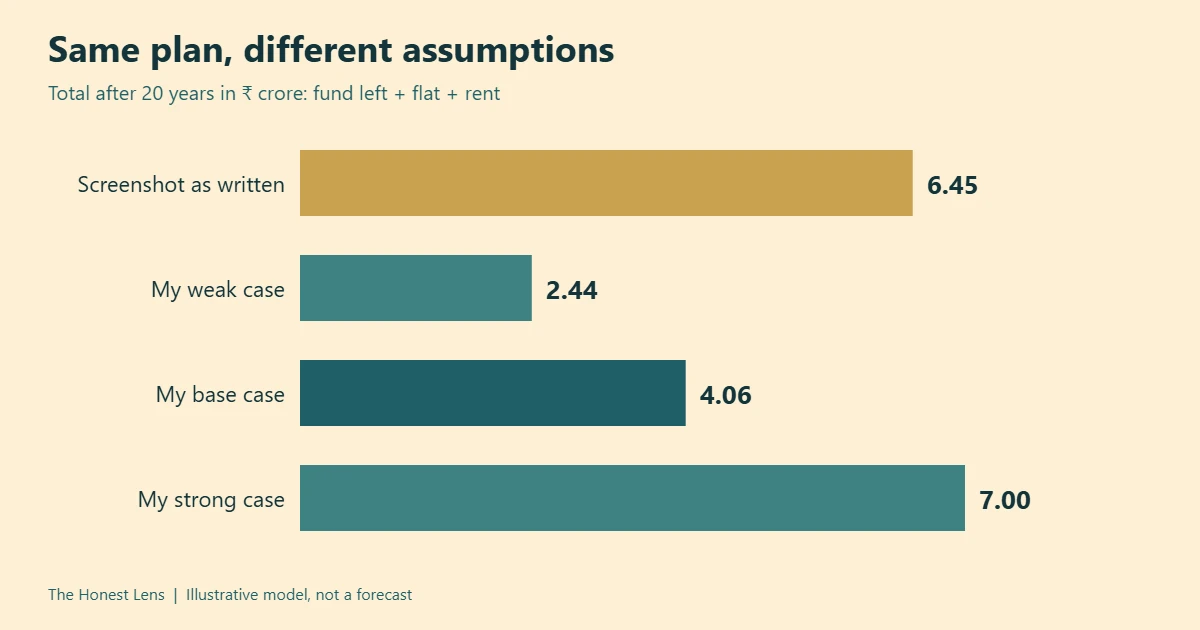
My three totals include about ₹0.85 crore of rent after costs and tax. The screenshot’s total leaves rent out. In the weak case the fund runs dry and you cover ₹45 lakh of EMIs from salary, which I subtract.
At 5% inflation, those totals are worth about ₹2.4 crore, ₹0.9 crore, ₹1.5 crore and ₹2.6 crore in today’s rupees.
The screenshot’s result is close to my strong case, not my base case.
The rent is real but smaller than it looks. I took 3.5% of the flat’s value in year one, rising 5% a year, minus 20% for maintenance and vacancy, then tax at 31.2%. Under the new tax regime, interest on a let-out flat can only be set against the rent. In the early years the interest is larger than the rent, and that loss cannot be used against your salary or carried forward.
How much return you need to pay home loan EMI with SWP
This table shows the fund left after 20 years, in ₹ crore, when the SWP equals the EMI and tax is paid. It leaves out stamp duty, so it is the friendly version.
| Fund return | Loan at 7.5% | Loan at 8.6% |
|---|---|---|
| 12% | 1.63 | 1.09 |
| 11% | 1.05 | 0.58 |
| 10% | 0.59 | 0.17 |
| 9% | 0.23 | runs dry |
The fund needs to beat the loan rate by about 1.5 to 2 points before anything is left. Then add the 6% stamp duty. In my base case it takes the fund left from about ₹40 lakh to nothing, because ₹6 lakh less is invested for 20 years.
The flat grows whether or not you pay home loan EMI with SWP. The money left in the fund is the only part the strategy earns, and that is the number to judge it by.
Five questions before you pay home loan EMI with SWP
- What fund return does it assume, and is tax taken out?
- What loan rate does it use, and is the loan floating?
- Are stamp duty and registration counted?
- How fast does it assume the flat rises?
- If the fund fell 30% in year two, could my salary cover the EMI?
My view: I would not pay home loan EMI with SWP as the only plan. I would keep the EMI payable from salary and treat the fund as optional. A roof over my family should not depend on one decade of market returns.
What I am not sure about
- The model is approximate. It takes tax on an average-cost basis and pays it out of the fund.
- The 6% stamp duty and the 20% running costs are my assumptions, not data.
- I could not tell who first wrote the screenshot, so I have not attributed it.
- Returns and flat prices here are planning assumptions, not forecasts.
FAQ
Can you pay home loan EMI with SWP?
Yes, the mechanics work. The fund sends the EMI amount to your bank account each month. Whether it lasts depends on the fund’s return against your loan rate. At my base numbers it lasts exactly 20 years with nothing to spare.
Is SWP better than prepaying a home loan?
Prepaying earns you the loan rate with no market risk. The SWP route wins only if the fund beats that rate after tax by a margin, and it can lose if markets fall early. At an 8% loan and a 10% fund, the margin is thin.
How big a fund do you need to cover a ₹70,000 EMI for 20 years?
If the fund pays out to zero at the end, about ₹66 lakh at 12% and ₹75 lakh at 10% before tax. After the 12.5% tax on gains, about ₹69 lakh and ₹77 lakh. At 9%, about ₹82 lakh after tax.
Is an SWP taxed?
Each withdrawal is part your own money and part gain. Gains on equity funds held for over a year are taxed at 12.5% above ₹1.25 lakh a year (see Section 198 of the Income-tax Act, 2025, which replaced Section 112A).
Related reading
- FIRE Number India: A Worked Example for a Couple Spending ₹1 Lakh a Month
- Mutual Fund Basics for Beginners in India
- Rent vs Buy House India: I Ran a ₹1 Crore Flat Against Renting and Investing
Last reviewed: November 2026. I am not a licensed financial adviser. This is a worked example, not a recommendation. Run your own numbers.






One Comment
Comments are closed.