
Rent vs Buy House India: I Ran a ₹1 Crore Flat Against Renting and Investing
The screenshot a friend sent me ends with a flat worth ₹5.11 crore and ₹1.34 crore in mutual funds, plus rent. If you will live in that flat, the rent vs buy house India question changes. You collect no rent, and the screenshot never compares buying with renting. So I ran that comparison on the same ₹1 crore.
The 30 second version
- If you live in the flat, what you gain is the rent you do not pay, plus the flat’s price growth.
- The fair test: a buyer who takes the loan and pays the EMI from an SWP, against a renter who invests the whole ₹1 crore and pays rent from an SWP.
- Base case (fund 10%, loan 8%, flat up 6% a year, 6% stamp duty, rent 3.5% of the flat’s value): the buyer ends with about ₹3 crore and the renter with ₹3.64 crore.
- Buying comes out ahead if the flat rents for more than about ₹36,000 a month, or if the flat rises about 8.5% a year while the fund earns 12%.
- The rent number decides it, so use what similar flats near you actually rent for.
Table of Contents
What changes when you live in the flat
No rent comes in. What you gain is the rent you would otherwise pay, and it never appears in any statement.
Tax changes too. Under the new tax regime, interest on a home you live in earns no deduction. Under the old regime, up to ₹2 lakh a year is deductible, which at a 31.2% tax rate saves about ₹11.5 lakh over the life of an ₹80 lakh loan. My tables leave that out, and adding it would not change the base case.
I wrote about the rented-flat version of the screenshot separately, with the plan’s own assumptions checked one by one. This rent vs buy house India post only asks what happens if you live in it.
A fair rent vs buy house India comparison
Two people start with the same ₹1 crore, want the same kind of flat and leave their salaries alone.
The buyer puts ₹20 lakh down, pays ₹6 lakh in stamp duty and registration, invests the other ₹74 lakh in a fund, and takes an ₹80 lakh loan at 8% for 20 years. The EMI is about ₹66,900, paid by an SWP. I add running costs of 20% of the rent a similar flat would fetch, which comes to about ₹23 lakh over 20 years.
The renter invests the whole ₹1 crore in the same fund. Rent is ₹3.5 lakh in year one, which is 3.5% of the flat’s value, rising 5% a year, and an SWP pays it.
Both pay 12.5% tax on equity gains above ₹1.25 lakh a year. Both live in the same kind of flat for 20 years.
The result
This table shows what each person owns after 20 years, in ₹ crore. The buyer’s figure is the flat plus any fund left, minus any shortfall paid from salary, minus running costs.
| Case | Buyer | Renter |
|---|---|---|
| Base (fund 10%, loan 8%, flat up 6%) | 2.98 | 3.64 |
| Weak (fund 8.5%, loan 8.7%, flat up 3.6%) | 1.35 | 2.47 |
| Strong (fund 12%, loan 7.5%, flat up 8.5%) | 5.93 | 5.82 |
In the base case the buyer owns a ₹3.21 crore flat and an empty fund. The renter holds ₹3.64 crore in funds and has paid every rupee of rent.
In this rent vs buy house India test, buying only came out ahead when both the flat and the fund did well.
The rent number decides it
Everything above uses a rent of 3.5% of the flat’s value, which is about ₹29,000 a month on a ₹1 crore flat. That is a generic number. When I changed only the rent, the answer flipped.
| Monthly rent for the ₹1 crore flat | Buyer | Renter |
|---|---|---|
| ₹25,000 | 3.01 | 4.09 |
| ₹29,000 | 2.98 | 3.64 |
| ₹33,000 | 2.94 | 3.19 |
| ₹37,500 | 2.91 | 2.74 |
| ₹42,000 | 2.88 | 2.29 |
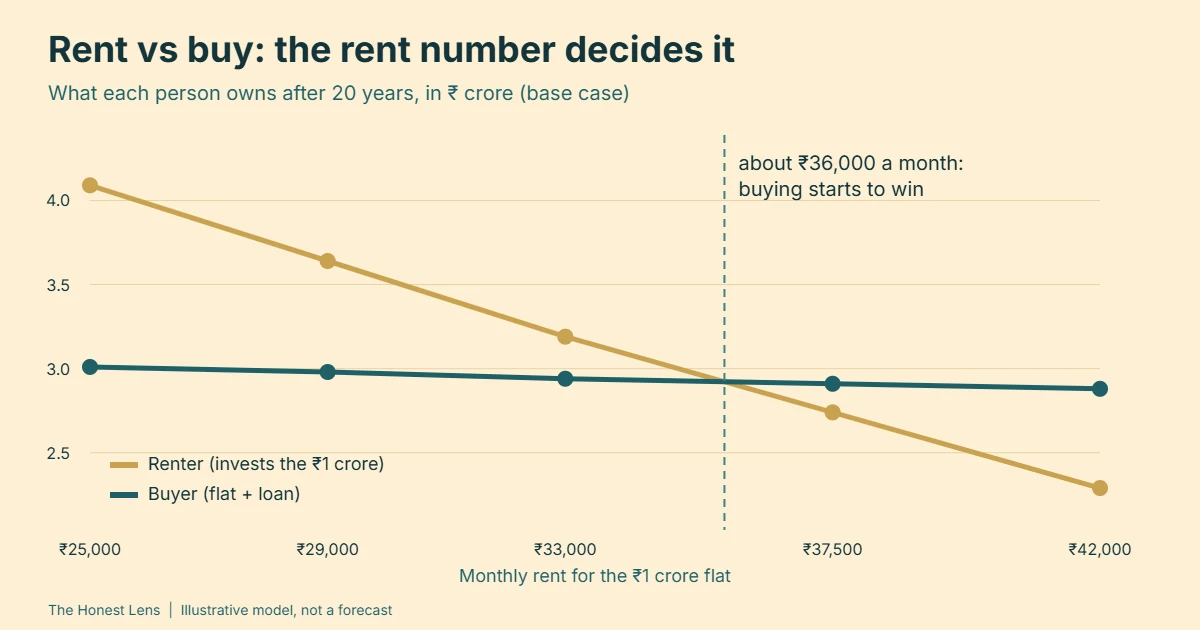
The flip sits near ₹36,000 a month. If a similar flat near you rents for more than that, buying does better in my base case. If it rents for less, renting and investing does. Look at what similar flats near you are listed at before you trust any rent vs buy calculator, mine included.
What a spreadsheet cannot price
- Stability. No landlord can ask you to leave, and no rent rise surprises you. It does not appear in any number above, and I value it.
- Discipline. The renter’s lead exists only if the ₹1 crore stays invested and untouched. Owning forces the saving. Renting leaves it to you.
- Market risk. The renter’s rent comes out of the same fund, so a bad first decade hurts the renter too.
- Exit cost. A renter can change city next month. A buyer pays heavily to leave early.
My view on rent vs buy house India: if you know you will stay in one city for 15 years or more, and similar flats rent above that line, buy. Otherwise renting and investing is not a mistake.
What I am not sure about
- The 3.5% rent, the 6% stamp duty and the 20% running costs are my assumptions, not data.
- The model is approximate. It takes tax on an average-cost basis and pays it out of the fund.
- Fund returns and flat prices are planning assumptions, not forecasts.
- I use one fund return for both people, which favours neither but ignores that a renter may invest more cautiously.
FAQ
Rent vs buy house India: which is better?
It depends mostly on rent against price. In my base case, renting and investing finished about ₹66 lakh ahead over 20 years. Buying pulled ahead once rent passed about ₹36,000 a month on a ₹1 crore flat.
How much rent makes buying worth it?
On my numbers, about 4.3% of the flat’s value a year, or roughly ₹36,000 a month for a ₹1 crore flat. Check it against listings for your own area.
Does the home loan tax deduction change the answer?
Not in my base case. The old regime allows up to ₹2 lakh of interest on a home you live in, worth about ₹11.5 lakh over this loan. The new regime allows none.
Should I use an SWP to pay a home loan EMI?
Only if the fund beats the loan rate after tax by a margin. I checked that for a rented flat in the other post.
Related reading
- Pay Home Loan EMI With SWP? I Re-ran a Viral ₹1 Crore Plan
- FIRE Number India: A Worked Example for a Couple Spending ₹1 Lakh a Month
- Early Retirement Planning in India: 6 Steps After 40
Last reviewed: November 2026. I am not a licensed financial adviser. This is a worked example, not a recommendation. Run your own numbers.





One Comment
Comments are closed.