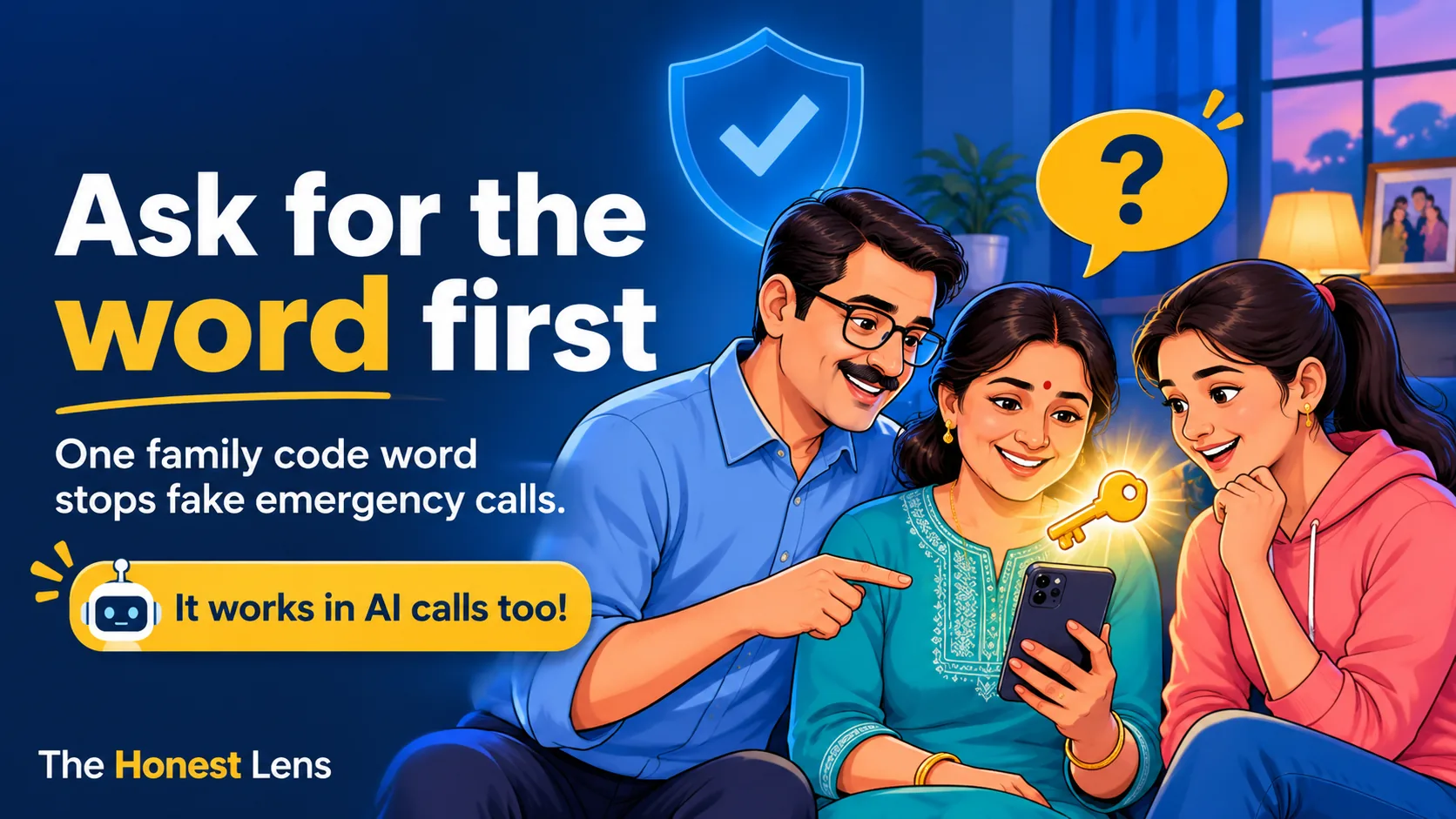
Family Code Word: The Ten-Minute Habit That Stops Fake Emergency Calls
A family code word is a word or phrase that only your family knows, and that anyone can ask for when a caller says a relative is in trouble. If the caller cannot say it, you stop. I think it is the most useful scam defence a family can set up this month, because it costs nothing and does not depend on spotting anything odd.
Many families have never heard of it. Think of it as an OTP for people. You would not approve a bank transaction without a one-time code, so do not send money on the strength of a familiar voice alone.
I have not tested this against a live scam call, and I could not find a published success rate for code words. Treat it as a sound habit, not a guarantee. The post also says where it does not help.
The 30 second version
- Scammers can now fake a relative’s voice, and a video call can be faked too. Hearing or seeing someone no longer proves it is them.
- Agree one word or phrase with your family, in person. Ask for it on any urgent call, video call or message that involves money.
- Never say the word first. Make the caller say it.
- It stops impersonation of a relative. It does not stop fake police or fake bank calls, so I have added a second family rule for those.
Contents
Why a familiar voice proves nothing now
Cloning tools need very little audio. I have not measured how little, but a reel, a voice note or a WhatsApp status is enough raw material to worry about. Faces can be faked on video as well.
The scammer does not have to be clever. They only need you frightened and in a hurry for a few minutes.
If the story needs money in the next ten minutes, the story is the problem.
How a family code word works
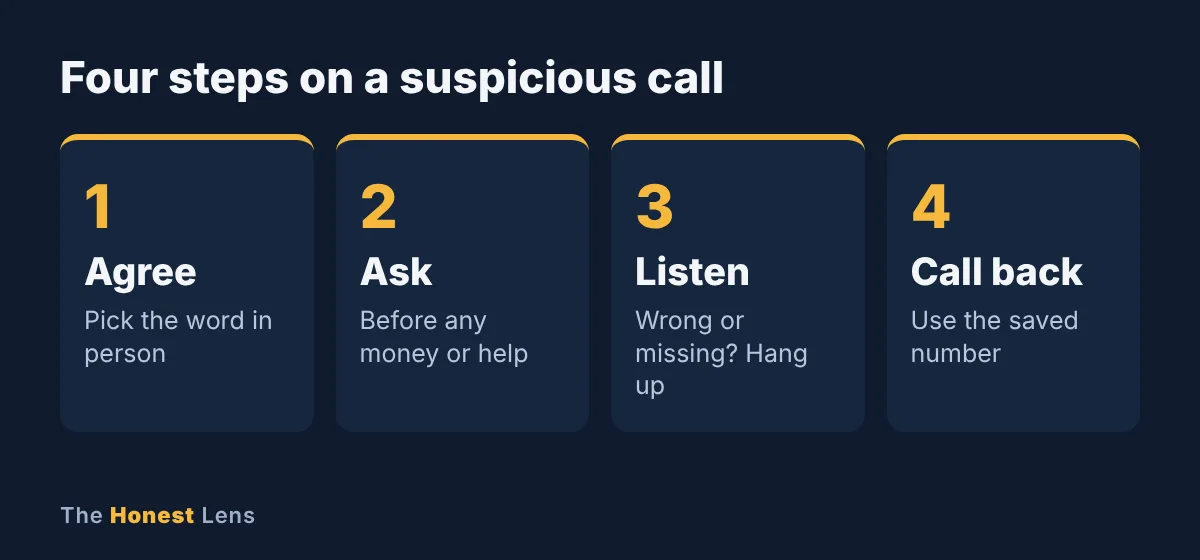
- You agree on the word or phrase with your family, in person.
- A call, video call or message arrives from “a relative” who needs help or money.
- You ask for the code word before you do anything else.
- A real relative answers at once. If the answer is wrong, missing or evasive, you hang up and call that person back on the number saved in your phone.
It works on any channel, which is its main advantage over listening for odd speech.
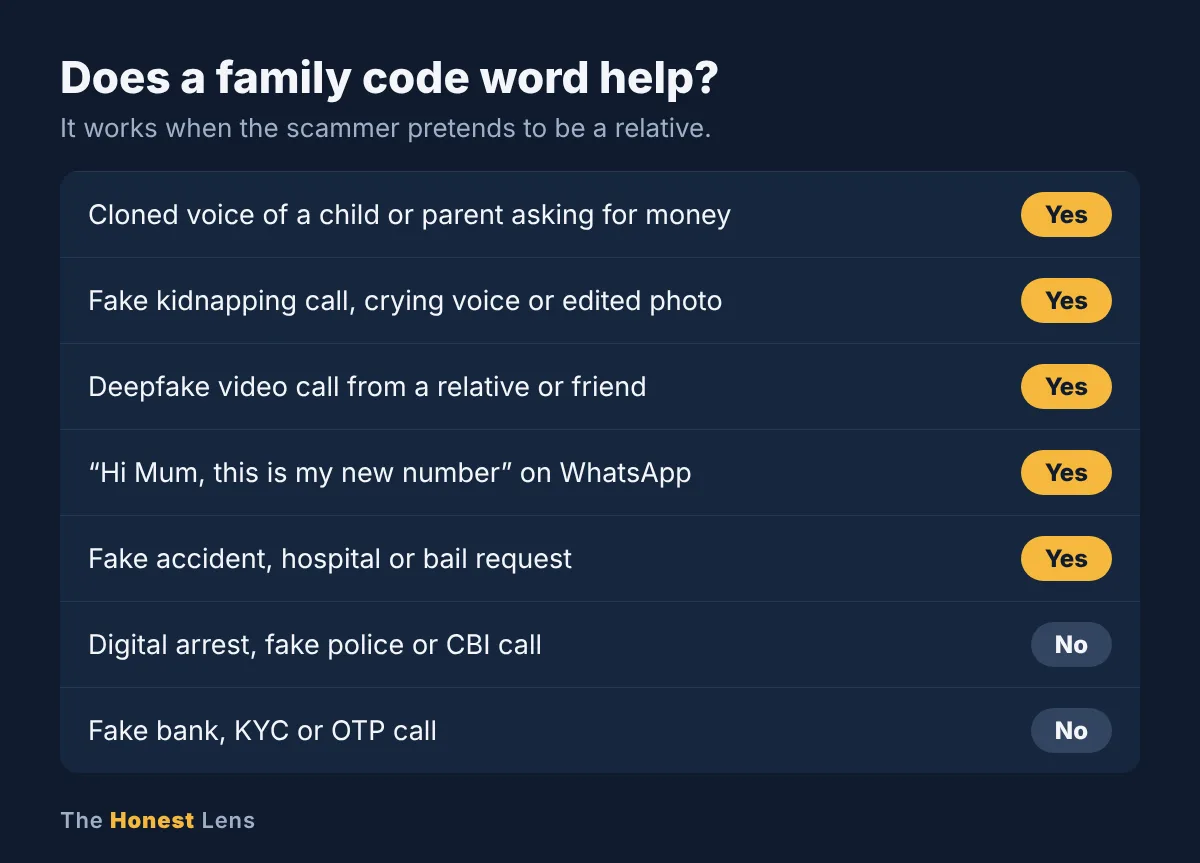
Which scams it stops, and which it does not
| Scam | Does the code word help? |
|---|---|
| Cloned voice of a child or parent asking for money | Yes |
| Fake kidnapping call, with a crying voice or an edited photo | Yes. Ask for it, then call the person directly |
| Deepfake video call from a relative or friend | Yes. Video proves nothing, the word does |
| “Hi Mum, this is my new number” on WhatsApp | Yes, and call the old number |
| Fake accident, hospital or bail request | Yes, when a relative is the supposed caller |
| Digital arrest, fake police or CBI call | No. Use the family rule below |
| Fake bank, KYC or OTP call | No. Never share an OTP with anyone |
In the last two rows the scammer pretends to be an officer or a bank, not a relative, so there is no family word to ask for. For those I use a plain family rule: nobody pays, installs an app or stays on a pressured call without telling one other family member first.
How to set one up
Choose it well
- Make it random or personal to the family. No pet names, birthdays, schools or cities, because anything on Instagram can be found.
- Use three or four unrelated words, not one. An inside joke from your family history works well and is easy to say.
Share it safely
- Agree on it in person or on a call. Do not post it in the family WhatsApp group or send it by text. A hacked phone or group gives it away.
- Include grandparents and teenagers. They are the ones most often called.
Use it correctly
- Never say it first. If you volunteer it, the scammer simply repeats it back. Make the caller produce it.
- A right answer is not the end of the check. If money is involved, still call back.
- Change it if anyone thinks it has leaked, and ask each other for it now and then. We use it so rarely that it is easy to forget.
- Agree a fallback for a forgotten word: a question only that person can answer, or a call back on a saved number.
- One extra idea, which is my own: a second “duress” word that means “I am being forced to say this”. Use it only if someone is in real danger.
Rehearse it, because panic erases memory
In a real scare, the likeliest failure is not a wrong word. It is that nobody remembers to ask.
So run a two-minute drill. Call your parents in a casual voice and say you are in trouble and need money. See whether they ask for the word. Do it kindly, with older relatives and with children, and expect the first attempt to fail. That is why you practise.
If you have no code word yet
Use the same steps every time:
- Hang up. Do not argue or bargain.
- Call the person back on the number saved in your phone, or call a relative who is near them.
- Do not pay by UPI, QR code, gift card or crypto until you have spoken to the real person.
- Treat urgency as the warning sign. A real emergency survives a two-minute call back.
For a kidnapping call, call the person first and the police next. Do not pay anything before you have heard from them directly.
Keep your family’s voice footprint small
This reduces how often the call comes. It does not replace the code word.
- Keep family social profiles private, and think before posting long public videos of children or parents speaking.
- Do not post travel plans or relatives’ names where strangers can see them.
- In WhatsApp privacy settings, limit who can see your profile photo and about line.
- Turn on two-step verification in WhatsApp, and never share its six-digit code.
If someone has already paid
- Call the bank at once and ask it to hold or reverse the transfer.
- Call the cybercrime helpline, 1930, as early as you can. I would do it in the first hour.
- File a complaint at cybercrime.gov.in.
- Tell the family the same day, because the scammer may try other relatives next.
- Do not blame the person who paid. These calls are built to beat careful people.
A message to forward to your family group
Family rule from today: if anyone in the family calls, messages or video calls asking for money or help in an emergency, we ask for our code word first. If they cannot say it, we hang up and call them back on their saved number. Nobody pays by UPI, QR code, gift card or crypto until we have spoken to the real person. I will tell each of you the word in person, not in this group.
Frequently asked questions
What is a family code word?
A word or phrase known only to your close family. When someone claiming to be a relative asks for urgent help or money, you ask for it to confirm it is really them.
Is a family code word the same as a family safe word?
Yes. “Safe word”, “code word”, “safe phrase” and “family password” all mean the same thing. Pick the term your family will remember.
What if someone forgets the code word?
Use the fallback: ask a question only that person can answer, or hang up and call back on a saved number. Never send money because the voice sounds right.
Does a code word stop digital arrest or fake bank calls?
No. Those scammers pose as officers or bankers, not relatives. The protection there is the family rule: tell one other person before you pay or follow instructions on a pressured call.
My takeaway
I would set a family code word before I bought another security app. It takes one conversation, and it works on a call, a video call and a WhatsApp message alike.
If you do one thing tonight, pick the word with your family and run the two-minute drill. For anything the word cannot cover, keep the second rule: tell one other person before you pay.
Want a daily three minute habit? BeCyberSmart.in runs a free scam-awareness quiz in English, Hindi, Marathi and Tamil.
Last reviewed: November 2026. Helplines, bank rules and portal links change, so check the current version before you act.
Related reading
- Why Tech-Savvy People Fall for Scams: Six Attacks Built for Smart Targets
- Call Forwarding Scam in India: Never Dial a Code That Starts With *
- WhatsApp Bank Alert Scam: Why You Should Never Reply NO
Official pages: National Cyber Crime Reporting Portal. Helpline: 1930.